
Cross Bronx Expressway (GMT Games, 2025)
A report/review of the board game Cross Bronx Expressway designed by Non-Breaking Space for GMT Games.

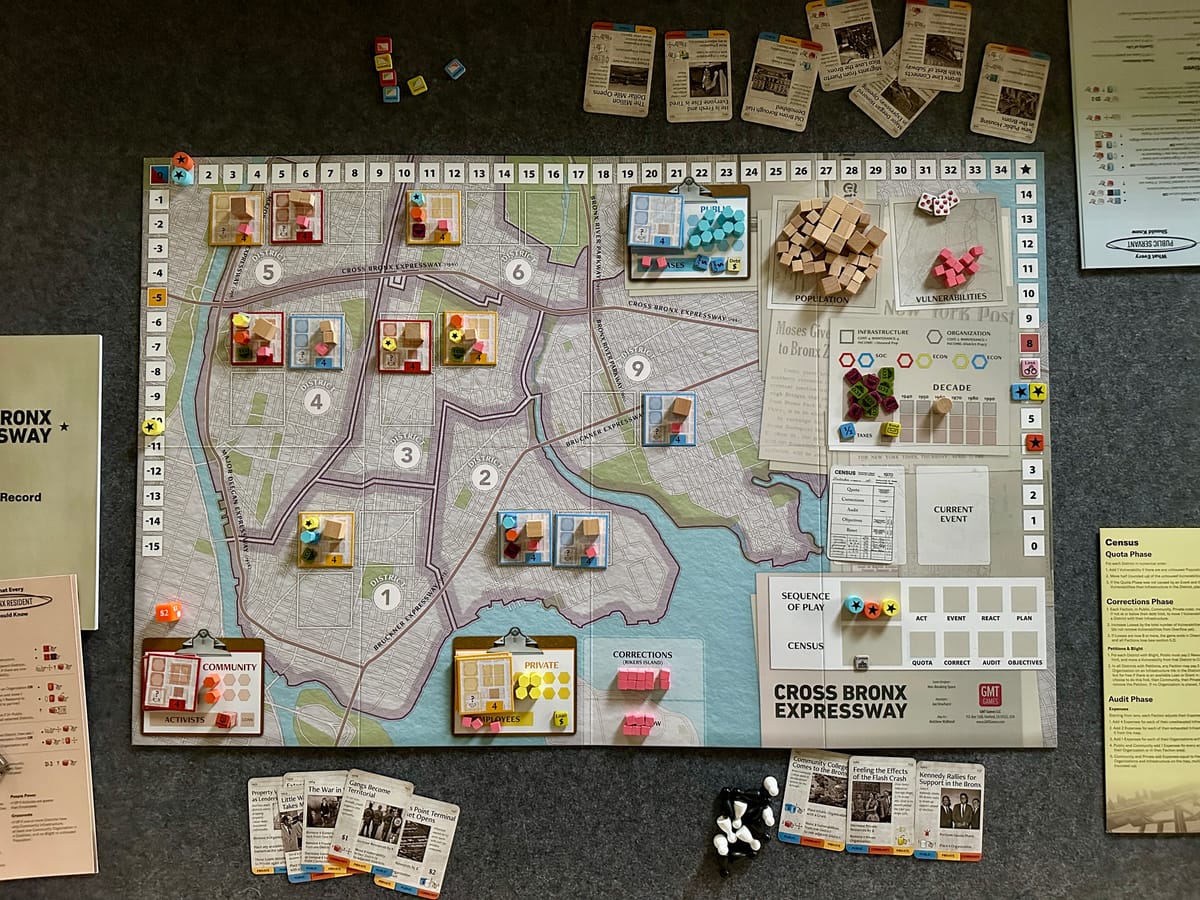
My weekly board game group has been enjoying/indulging my interest in historical conflict games this past year, particularly the GMT Games series COIN (COunter-INsurgency). These are asymmetrical war-games that attempt to model the push and pull dynamics between insurgent forces and the governmental forces attempting to counter their tactics. The series has expanded into a sister series called ICS (Irregular Conflict Series) that uses inspiration from COIN to model other types of conflicts: the competing empires of medieval India, the tale of insurgent folk hero Robin Hood, and most recently, the real life costs of running an expressway through a vibrant neighborhood.
Cross Bronx Expressway was designed by Non-Breaking Space, a pseudonym for someone whose real life work is related enough to the subject matter that he wishes to remain obscured. Fair...and fascinating. I highly recommend checking out the Endnotes podcast episode he produced to supplement the already robust "Historical Record" included with the game. It gives a lot of context for why he designed it the way he did. A certain segment of people hearing about this game will think of two things: the infamous "The Bronx is Burning" incident and Robert Moses, the man responsible for building the Cross Bronx Expressway. His story is immortalized in the massive biography The Power Broker, famous in its own right on the bookshelves of every politician (and celebrity).
All of the historical context is good to know (I'm slowly reading The Power Broker myself), but the board game is absolutely fascinating in its own right. I've played it a few times solo and a couple times with my group. Both times with the group, I was apprehensive about how it would be received. It is not exactly a feel good time. Sure, you can play the Community, the scrappy representative of the neighborhood fighting the good fight, but even they have to introduce Vulnerabilities into the game to survive. On the other hand, you can play the Private interests providing loans and money for this great work (until they ship people out in the hopes of attracting higher paying residents). Surely the Public is just out for the good of the neighborhood, right? Well, no, they certainly try but the Public is overworked and can only take so many cases in. They don't mind moving people in to the area, though.
Every side in this three player game thinks they are doing something good, but can't help but make things worse at times. We just barely survived hitting the Disenfranchisement threshold of 8 Losses when all those excess Vulnerabilities you had to take on come back to bite you. An interesting dynamic of this most recent play was that the Public faction was being played by someone who works in social services for our city. He immediately picked up the game's flow and related it to the job he just came from an hour or two previously. The game we played inspired him to talk about why he loves his work and he wondered aloud what this game would be like if it was played completely cooperatively with the goal to make the Community win. The Community player had played Community in the previous game and he remarked how hard it was get anywhere. Which, of course, is one of the points. With the apparatus of the government and outside investors arrayed against you, what hope does the neighborhood have?
In the end, Public and Private tied, with Community trailing behind. A not inaccurate reflection of history. Given that we barely cleared the Losses threshold due to how many Vulnerabilities we had, it's a hollow victory. Those Vulnerabilities are the key to the game, in my opinion. An abstracted representation of all the ways in which a large project like this introduces unintended consequences into the community, that might be felt for years after (the game has six decades of history you can play with). Does the Community need money? They might have to ask criminal elements. Does Public want to build some low cost housing? They need to move people in from other areas to justify it. Does Private want to recoup their investment? Eviction time. Each of these actions introduces Vulnerabilities, which spill out onto the street, until they are swept up into the system and push it to breaking.
It sounds depressing, but I see it more as another way to learn about the consequences of thinking you can solve other people's problems. The expressway is the root cause of what happens here, but the efforts of all three factions to solve the problems it caused is just as important to understand. I'm fascinated by that domino effect and how the model in this game reflects the wider world's issues. I've always felt "move fast and break things" to be an arrogant worldview, because often those things are people. The more humanistic approach is "move carefully and help people." Cross Bronx Expressway teaches that lesson well.