Chicago '68 (The Dietz Foundation, 2025)
Three and half days of political action and chaos as the whole world watches in Chicago '68 designed by Yoni Goldstein.

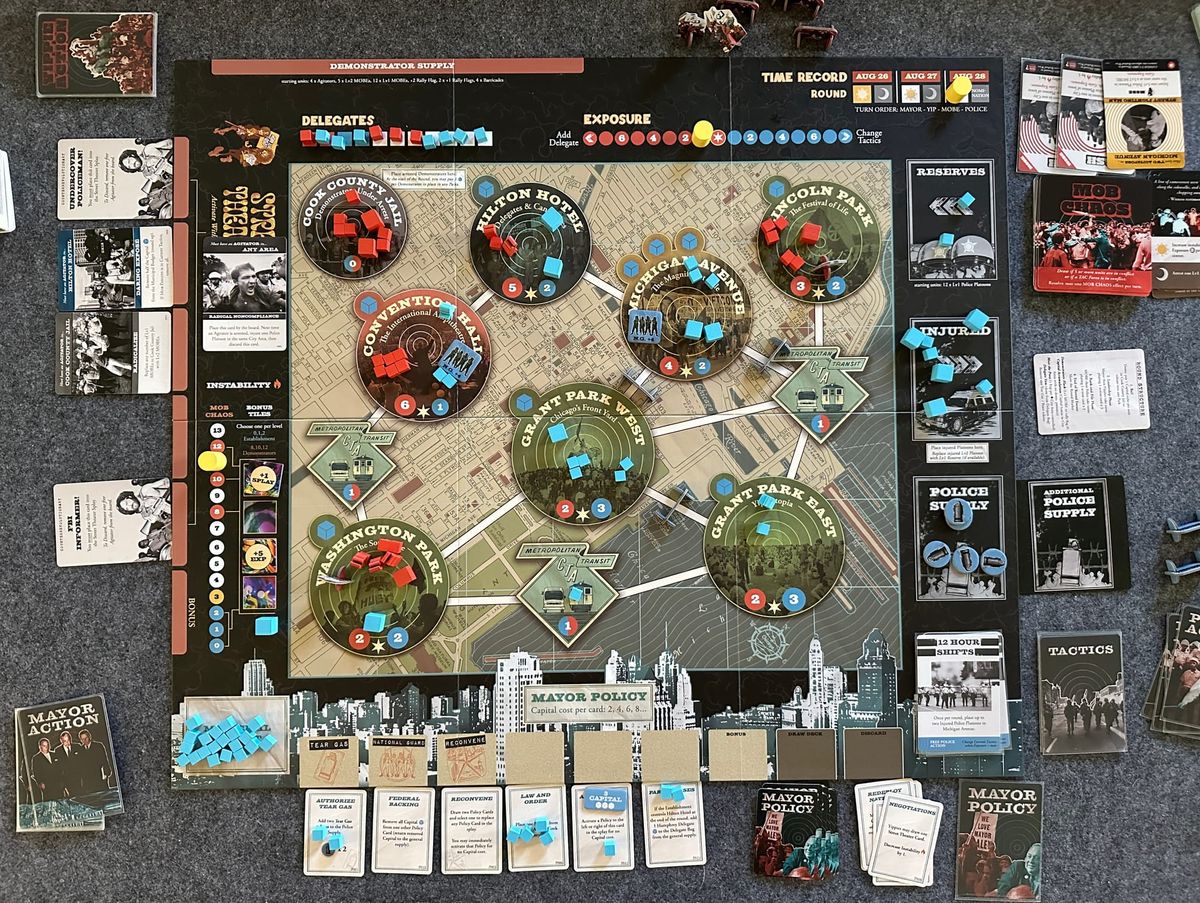
Caveat: I've only played Chicago '68 twice. Both plays used the same setup: four players, normal turn order, no Incendiary Events. I'm hoping to try the other modes in future plays, including the solo system, but I wanted to share some thoughts before too much time has passed.* Which is to say up front that this is a game I will be happily returning to. Especially since my weekly game group has really enjoyed these first plays.
The first thing notable to me about Chicago '68 is its scale, presenting a zoomed in look at protest dynamics and the counter tactics used by cities and police. The conflicts literally take place in parks, transit stations, and hotels. After all, the 1968 protests at the Democratic National Convention didn't take place over an entire city, but they did encompass a sizable portion of the area around the Convention. This smaller scale reveals quite a lot about how protests work, how they fail, and how authorities combat them. Also, a lot about how they can spiral out of control.
Another notable aspect to Chicago '68 is how it handles asymmetry. In the four player game, players are divided into two teams, The Establishment (The Mayor and The Police) vs The Demonstrators (The Yippies and the MOBE). Team games are quite interesting but I haven't played many that felt as dynamic as this one. Many times you run into alpha player problems where one person just tells everyone what they should be doing. That's not fun or interesting at all. Chicago '68 circumvents that problem elegantly with a mechanical fog of war. Each player has a unique set of action cards and the Demonstrators have somewhat conflicting goals which introduces enough individual bias into the game that it keeps the Establishment on its toes.
The action cards aren't the only mechanics that contribute to that asymmetric fog. The Leadership factions, The Mayor and The Yippies, mirror each other by both having tracks of cards they can access, but the way they access them is completely different. The Mayor uses a budget (largely accumulated through controlling spaces and bail money) to enact various Policies, while the Yippies have the wonderfully titled Street Theater cards. The Mayor's Policies get more expensive the more they use the same ones, forcing them to change political tactics. Street Theater cards mimic the outlandish ways The Yippies would try to capture attention and are mostly governed by their Agitator pieces. Agitators rove around the board, leading the masses, rallying more to the cause, and stirring up trouble.
The Rank & File factions, The MOBE and the Police, are your classic boots on the ground responsible for mobilizing large numbers to surround or overwhelm the opposition. They rely on Leadership to give them the resources to do this. Having the factions divided up this way is what makes the team game so interesting and realistic. Who hasn't been at odds with their own leadership despite having the same basic goals? Many political action groups suffer from this friction, but it's also prevalent in any corporation or entity with a hierarchy. Chicago '68 skillfully uses this friction to show how the DNC protests went haywire on both sides.
For the Demonstrators, the Yippies are primarily concerned with Exposure: how much press they are getting. The MOBE are brass tacks: they want more like-minded Delegates in the actual convention to elect their chosen anti-war candidate (Eugene McCarthy). For the Establishment, the goals are more aligned but the tactics less so. The Mayor is trying to keep the city under control with his limited budget. He has to make decisions based on money. The Police are confronted with massive, unruly crowds running around the city. They make their decisions based on how to contain them. Those decisions can be at odds with each other.
Overall, Chicago '68 is half political, half tactical by nature and that mixture illuminates the way the two opposing sides let things get out of control. Players really see the difference between those who want to get practical things done and those who want to look good for the press. In today's fraught climate where things clearly need to change, but we are besieged by social media's influence on action, the lessons modeled in Chicago '68 come through loud and clear.
[Addendum: I completely forgot to mention that a big part of what has made my plays of this really enjoyable was the killer soundtrack that the designer put together. Spotify. Apple Music.]
*Those looking for a much more experienced review should read Dan Thurot's excellent review on his equally excellent Space-Biff blog.